
Hougang Vending Machine Accident: The Risk Assessment Lesson for Every Business
A man had his hand stuck in a juice vending machine on 2 August 2026. The cause is still under investigation. Your risk assessment has to cover customers and passers-by too.
 By Nachi Leong, Principal Consultant7 min read
On the evening of 2 August 2026, a man got his hand and forearm stuck in an iJooz juice vending machine at Hougang Street 91. He was freed and taken to hospital as a precaution, and the cause is still being investigated. Nothing is settled about that case, and this article is not a finding against anyone.
On this page
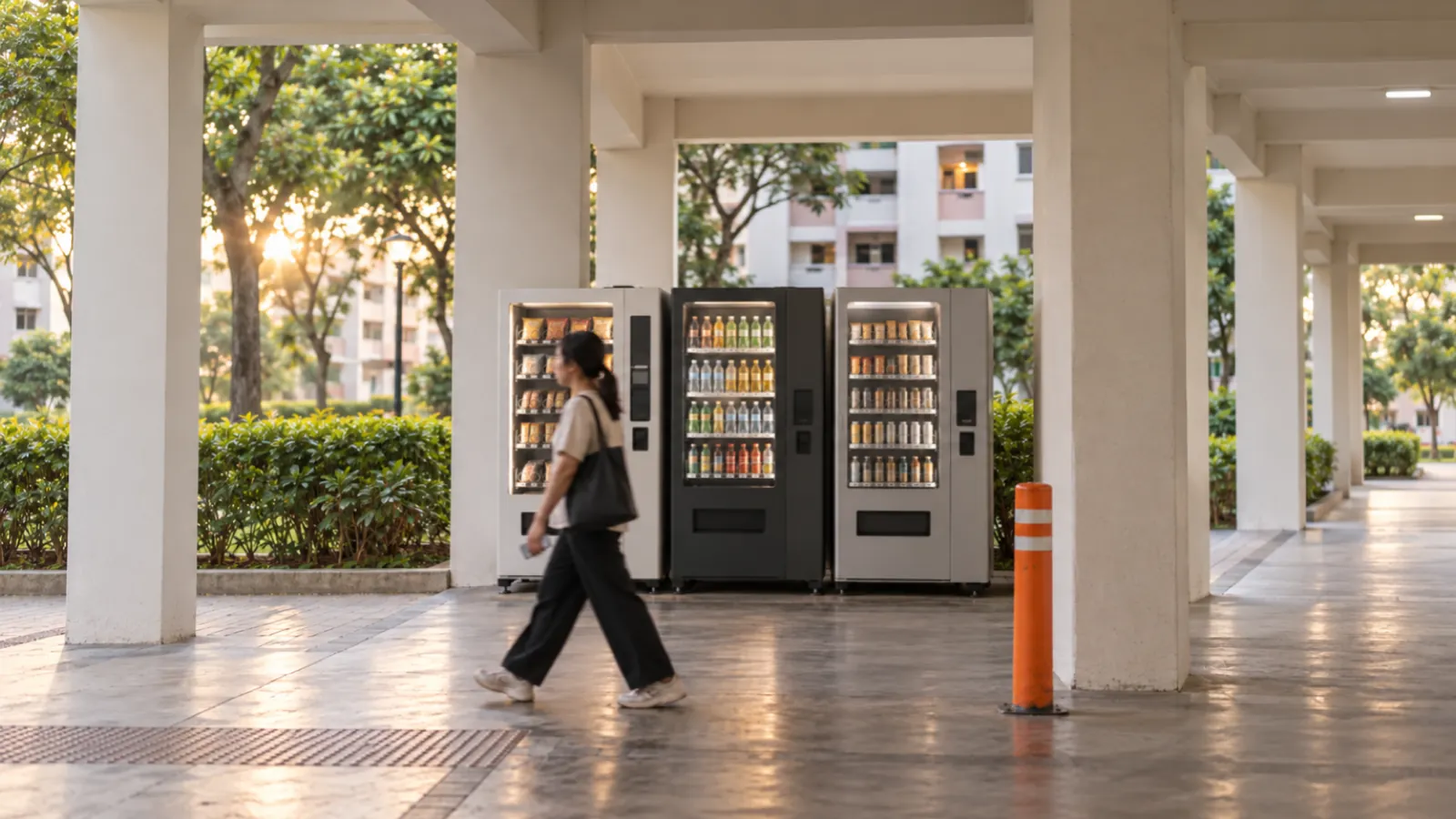
What is already settled is the legal position for every other business in Singapore. The WSH (Risk Management) Regulations require a risk assessment for the safety and health risks posed to any person who may be affected by your undertaking, and the WSH Act puts a matching duty on occupiers to keep their premises and equipment safe for everyone there, whether or not that person is at work. If the public can reach it, it belongs in your risk assessment.
Key takeaways
- Regulation 3(1) says "any person who may be affected by his undertaking", not "any employee".
- Section 11 of the WSH Act makes the occupier responsible for machinery and equipment kept at the workplace, for everyone on the premises.
- An unmanned site does not remove the duty. Restocking and servicing are still work carried out there.
- Assess for misuse, not just correct use. A customer has no training, no briefing and no PPE.
- After any injury from a workplace hazard, the law requires the risk assessment to be reviewed and revised.
What happened in Hougang
SCDF received a call for assistance at about 7.50pm on 2 August 2026 and took one person to Sengkang General Hospital. Police and other uniformed personnel were at the scene, and a video of the incident circulated widely online. The operator said a technician released the man's hand, that he was not injured after a precautionary medical check, and that an inspection of the machine found no obvious abnormalities. The unit was taken out of service for a full technical assessment, and the cause remains under investigation.
Two things are worth separating here. The first is what went wrong with that specific machine, which is for the investigation to establish. Every other business should check whether its risk assessment covers people who are not on its payroll.
Does a risk assessment have to cover members of the public?
Yes. Two provisions say so, and they point the same way.
Regulation 3(1), WSH (Risk Management) Regulations
In every workplace, the employer, self-employed person and principal must conduct a risk assessment in relation to the safety and health risks posed to any person who may be affected by his undertaking in the workplace. The wording is deliberately wide. Customers, visitors, delivery drivers, contractors and passers-by are all "any person".
Section 11, WSH Act 2006
Every occupier of a workplace must take, so far as is reasonably practicable, measures to ensure that the workplace, the means of access and egress, and any machinery, equipment, plant, article or substance kept there are safe and without risks to health. That duty is owed to every person within the premises, whether or not the person is at work and whether or not they are your employee.
In plain terms: if you keep a machine somewhere the public can reach it, its safety is your problem, and the risk assessment is the document that proves you thought about it before anything happened.
Where the gap usually is
Most SME risk assessments are built around worker tasks. Forklifts, working at height, chemicals, machinery in the workshop. That is where the injuries usually happen, so that is where the attention goes.
The gap opens wherever the public touches your equipment or your premises but no employee is standing there:
- Self-service kiosks, vending machines, lockers and automated dispensers.
- Doors, shutters, gates and barriers that customers pass through.
- Display racking, shelving and signage in customer areas.
- Wet floors, ramps, kerbs and loading bays used by visitors and delivery drivers.
- Equipment left unattended during restocking, cleaning or servicing in a public corridor.
- Car park and driveway movements where reversing vehicles meet pedestrians.
How to assess public-facing equipment and areas
The method is the standard 3-step MOM approach: identify the hazard, evaluate the risk, control the risk. What changes is who you picture using the thing.
- 01Walk the site as a customer, not as the owner.
Anything a member of the public can touch, open, lean on, climb or put a hand into goes on the list. Include the areas they are not supposed to enter but can.
- 02Identify hazards from misuse, not just correct use.
Assume someone will reach into an opening, force a flap, let a child use it, or try to retrieve a stuck item themselves. "The user should not have done that" is not a control.
- 03Rate the risk with the affected person in mind.
A member of the public has no training, no briefing and no PPE, so the same hazard usually scores higher for them than for a trained technician. Use one consistent 5x5 matrix across the whole assessment.
- 04Apply the hierarchy of control.
Design the hazard out first. Guarding, interlocks and sensors next. Instructions and signage last, never first.
- 05Decide the inspection and response routine.
Who checks it, how often, what gets recorded, and how fast someone can attend when a member of the public calls. At unmanned sites this control does most of the work.
- 06Review when something changes.
New equipment, new location, a complaint, a near miss or an injury. Record the review date and what changed.
Our free risk assessment template already has the columns for this, including persons at risk, so you can add the public-facing items straight into your existing form.
Controls that hold up
Auditors and investigators judge controls by where they sit in the hierarchy, not by how much paperwork surrounds them.
| Level | What it looks like for public-facing equipment | Strength |
|---|---|---|
| Elimination | Remove the opening, the pinch point or the unattended unit entirely | Strongest |
| Substitution | Swap in a model without the exposed mechanism or hot surface | Strong |
| Engineering | Fixed guarding, interlocks, sensors, an accessible stop, restricted opening size | Strong |
| Administrative | Clear usage instructions, visible helpline, inspection routine, response time | Supporting |
| PPE | Not available. You cannot issue PPE to a customer | Not applicable |
If a member of the public is hurt at your premises
Reporting duties depend on the circumstances. Under the WSH (Incident Reporting) Regulations, an occupier must notify the Commissioner for WSH when a member of the public dies, or is injured and taken to hospital, as a result of work carried out at the premises. Not every public incident meets that test, so check the specifics rather than assuming either way. Our guide to incident reporting in Singapore covers what is reportable and the 10-day deadline.
Whether or not it is reportable, the sequence is the same:
- 01Make it safe.
Secure the area and take the equipment out of service if there is any doubt about it.
- 02Record it while it is fresh.
Time, place, people, what the person was doing, photos of the condition before anything is repaired.
- 03Investigate the cause, not the behaviour.
Ask why the hazard was reachable at all, and why the existing controls did not stop it.
- 04Revise the risk assessment.
Regulation 7 requires a review whenever a person suffers bodily injury from a hazard at the workplace, or when work practices change significantly. Waiting for the 3-year cycle is not an option.
- 05Brief the team and file the records.
Keep the revised assessment and the investigation notes for at least 3 years. This is exactly what an inspector or auditor asks for.
If your company is bizSAFE Level 3 certified, this loop is what the auditor looks for at renewal: the incident, the investigation, the revised risk assessment and proof that people were briefed. In an ISO 45001 system it is a standing requirement, so a working system turns an incident into a routine process instead of a scramble.
Related: Rainforest Wild Adventure: the safety measures behind the thrills. A public attraction that gets the controls right, from a ride stopped on a fault to layered barriers.
How ZES helps
We build risk assessments that cover the whole site, including the parts the public touches, and we keep them practical enough that your team maintains them after we leave. The consultant you meet is the consultant who stays with your project. Our bizSAFE Level 3 package is from $1,888, with the Risk Management audit included in the quoted package. The final fee depends on company size, nature of operations and the scope of Risk Management work required.
Frequently asked questions
What happened in the Hougang vending machine incident?
On 2 August 2026, a man got his hand and forearm stuck in a juice vending machine at Hougang Street 91. SCDF was called at about 7.50pm and took one person to Sengkang General Hospital. The operator said a technician released his hand, that he was not injured after a precautionary check, and that the machine was withdrawn for a full technical assessment. The cause is still under investigation.
Does a risk assessment have to cover members of the public?
Yes. Regulation 3(1) of the WSH (Risk Management) Regulations requires a risk assessment for the safety and health risks posed to any person who may be affected by your undertaking in the workplace. That covers customers, visitors, delivery drivers and passers-by, not only employees.
We have no employees at the site. Does the duty still apply?
The occupier duty under section 11 of the WSH Act applies to the workplace and to any machinery or equipment kept there, and it protects every person within those premises whether or not they are at work. An unmanned site does not remove the duty, and restocking or servicing visits are themselves work carried out at the premises.
Is signage enough of a control?
Rarely. Signage is an administrative control near the bottom of the hierarchy of control. If a hazard can be designed out, guarded or interlocked, the law expects you to do that first, so far as is reasonably practicable.
Do we have to report an incident involving a member of the public?
It depends. An occupier must notify the Commissioner for WSH when a member of the public dies, or is injured and taken to hospital, as a result of work carried out at the premises. Injuries unconnected to work carried out there may fall outside the reporting regulations. When it is unclear, the safer course is to report and let MOM assess it.
How often should a risk assessment be reviewed?
At least once every 3 years, and immediately after an injury from a workplace hazard, a significant change in work practices, new equipment or a new process. Record the review date and what changed.
Where do we start if we have no risk assessment at all?
Start with an inventory of activities and equipment, including everything the public can reach, then work through hazard identification, risk evaluation and control for each one. Our risk assessment guide walks through the 3-step MOM method and the template gives you the format auditors expect. WhatsApp us at 8901 2255 if you want yours reviewed before an audit.
One consultant. From start to finish. The consultant you meet is the consultant who stays with your project.
About Nachi